
To choose the right hinge, first decide where the door sits. For cabinet and wardrobe shutters, use a concealed (auto) hinge and pick the crank by overlay: 0 crank for full overlay, 8 mm crank for half overlay, 16 mm crank for inset doors. Choose soft close for kitchens and wardrobes, and use 165–170° hinges for corner units. For room and main doors, use stainless steel butt hinges (4 inch for internal doors, 5 inch for heavy main doors), at least 3 per door.
- Cabinet shutters use concealed (auto/Euro) hinges with a 35 mm cup.
- Crank decides overlay: 0 = full overlay, 8 mm = half overlay, 16 mm = inset.
- Taller or heavier shutters need more hinges: roughly 2 up to 900 mm, 3 up to 1600 mm, 4 up to 2000 mm.
- Room doors use butt hinges; heavy main doors need 5 inch, thicker or ball-bearing hinges.
- SS 304 resists rust far better than SS 202, which matters in bathrooms and kitchens.
Why choosing the right hinge matters
A hinge is a small part, but it carries the whole weight of a door every single time it opens. Pick the wrong crank and the shutter will not line up with the carcass. Use too few hinges and the door sags. Use cheap steel near a sink and it rusts within a year.
At our Dhakoli store, customers often ask for "auto hinge" without knowing there are three different cranks, several opening angles and two ways of fixing. So this guide covers both kinds of hinges most homes need: concealed hinges for cabinets and wardrobes, and butt hinges for room and main doors.
Concealed (auto) hinges: choose the crank first
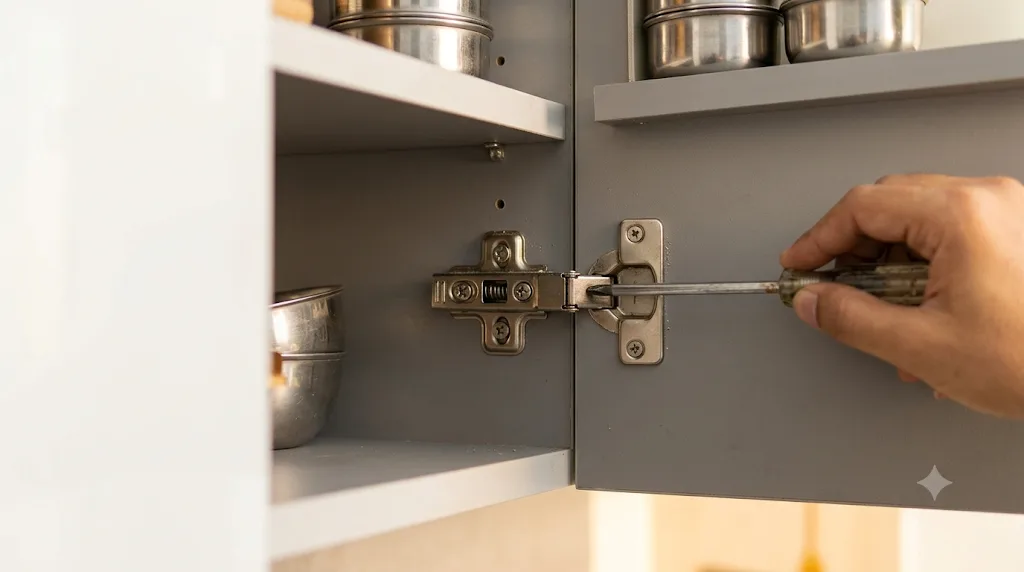
Concealed hinges, also called auto hinges or Euro hinges, sit inside the cabinet and are invisible from outside. The hinge cup fits into a 35 mm hole bored into the back of the shutter. The most important choice is the crank, which sets how the shutter sits over the side panel.
| Crank | Also called | Door position | Where to use |
|---|---|---|---|
| 0 crank | Full overlay, straight arm | Shutter covers the full edge of the side panel | End cabinets, single-door units, most wardrobes |
| 8 mm crank | Half overlay, half bend | Two shutters share one middle partition, each covering half | Middle panels of kitchen rows and wardrobes |
| 16 mm crank | Inset, full bend | Shutter sits inside the carcass, flush with the front | Inset-style furniture, some crockery units |
Shop-counter tip: Not sure which crank you have? Close the door and look at the side panel edge. If you can't see it, it's 0 crank. If you see half of it, it's 8 mm. If the door sits inside the frame, it's 16 mm. Or simply bring an old hinge to our store.
Opening angle and special hinges
- 95–110°: The standard hinge for most kitchen and wardrobe shutters.
- 165–170°: Wide-angle hinges for corner units and cabinets with internal pull-outs, so the door swings fully clear.
- Corner / angle hinges: For blind-corner units and angled (e.g. 30° or 45°) cabinets.
- Glass door hinges: Special cup-less or clamp hinges for glass crockery shutters.
- Thick door hinges: For shutters thicker than standard 18–19 mm, such as those with extra cladding.

How many hinges does a door need?
Most brands, including Hettich and Blum, publish a hinge-count guide based on door height and weight. As a practical rule for 18 mm plywood shutters:
| Shutter height | Concealed hinges needed |
|---|---|
| Up to about 900 mm | 2 |
| 900–1600 mm | 3 |
| 1600–2000 mm | 4 |
| 2000–2400 mm | 5 |
Add one extra hinge if the shutter is wider than about 600 mm, has a mirror, or is heavily laminated or clad. For room doors, use 3 butt hinges on a normal flush door and 4 on a tall, solid or heavy main door.
Soft close, clip-on and 3D adjustment
- Soft close: A built-in damper closes the door gently. It is worth it for kitchens and wardrobes, especially with children at home. Some systems use a separate clip-on damper instead of an integrated one.
- Clip-on vs slide-on: Clip-on hinges snap onto the mounting plate, so shutters come off without tools for cleaning or polishing. Slide-on hinges are cheaper but slower to remove.
- 2D vs 3D adjustment: 3D hinges adjust side, height and depth, which makes it easy to line up a whole kitchen of shutters neatly.
- Finish: Nickel-plated steel is standard. For sink cabinets or wet areas, stainless steel hinges last much longer.
Door hinges: size, material and type for room and main doors
Wooden and flush doors use butt hinges, fixed into shallow cut-outs on the door edge and frame (chokhat).
| Door | Hinge size | Quantity | Material |
|---|---|---|---|
| Bedroom / internal flush door | 4 inch (100 mm) | 3 | SS 304 or good SS 202 |
| Bathroom door | 4 inch (100 mm) | 3 | SS 304 (rust resistance) |
| Heavy main / solid wood door | 5 inch (125 mm), thicker plate, ball-bearing | 4 | SS 304 or solid brass |
| Small cupboard / window shutter | 2.5–3 inch | 2 | SS or brass |
Signs of a good hinge
- Thick plate that does not flex by hand
- Tight knuckle with no wobble in the pin
- Ball-bearing or washer knuckles on heavy doors
- Grade (SS 304) clearly marked on the pack
- Countersunk holes that sit screws flush
Warning signs
- Very light, thin plates
- Loose pin that rattles
- "Stainless" hinges that attract a magnet strongly and have no grade marked
- Rough edges or uneven holes
Why does steel grade matter? SS 304 contains more nickel and chromium than SS 202, so it resists rust better in humid areas. You can read about stainless steel grades here.
Which hinge should you buy?
Kitchen base and wall units
Soft close clip-on auto hinges: 0 crank on end units, 8 mm on shared partitions.
Tall wardrobe shutters
Soft close 0 or 8 mm crank, 4–5 hinges per 2100 mm shutter.
Corner and pull-out units
165–170° wide-angle hinges so the door clears the internal fittings.
Room and main doors
4 inch SS 304 butt hinges (3 per door); 5 inch ball-bearing hinges (4 per door) for heavy main doors.
Comparing hinge brands? See Hettich vs Ebco, Hettich vs Blum and, for door hardware, Dorset vs Ozone. Choosing the door itself? Read flush door vs UPVC door and best flush doors in Chandigarh. For drawers in the same kitchen, see how to choose a telescopic channel, and for pulls and door levers, how to choose door and cabinet handles. More guides are in How to Choose.
Find the right hinges at our Dhakoli store
Bring an old hinge or a photo of your cabinet, or WhatsApp us your door size, and we will match the right crank, size and brand. Need fitting too? Book our carpenter service.
SCO 13, Ground Floor, Srishti Plaza, opp. DWPS, Dhakoli, Zirakpur 160104 · Free delivery above ₹500 in Dhakoli & nearby
Frequently asked questions
How do I know which auto hinge crank I need?
Look at how the shutter sits on the side panel. If it covers the full edge, you need a 0 crank (full overlay) hinge. If two shutters share one partition and each covers half, you need an 8 mm crank (half overlay). If the shutter sits inside the cabinet frame, you need a 16 mm crank (inset) hinge.
How many hinges should a cabinet or wardrobe door have?
As a rule of thumb for 18 mm shutters, use 2 hinges up to about 900 mm height, 3 hinges for 900–1600 mm, 4 hinges for 1600–2000 mm and 5 hinges for 2000–2400 mm. Add one more hinge for wide, mirrored or heavy shutters.
Are soft close hinges worth the extra cost?
For kitchens and wardrobes, yes. Soft close hinges stop doors from slamming, reduce wear on the cabinet and hinges, and protect small fingers. For rarely used storage units, normal hinges are fine.
Door hinge questions
What size hinge is used for a room door in India?
Most internal flush doors use 4 inch (100 mm) stainless steel butt hinges, 3 per door. Heavy main doors or solid wood doors should use 5 inch (125 mm) hinges with a thicker plate or ball bearings, usually 4 per door.
Which is better, SS 304 or SS 202 hinges?
SS 304 hinges are better because they contain more nickel and chromium, so they resist rust much better. They cost more, but for bathroom doors, kitchens and humid areas, SS 304 is the safer choice. SS 202 is acceptable for dry indoor doors on a budget.
What is a 165 or 170 degree hinge used for?
A 165 or 170 degree hinge lets a cabinet door open very wide. It is used for corner cabinets and for units with internal drawers or pull-out baskets, where a standard 110 degree hinge would stop the door from clearing the fittings.
Which brand of hinges is best?
Hettich, Blum, Häfele and Ebco are the most trusted brands for concealed cabinet hinges in India. For door butt hinges, choose a brand that clearly marks the steel grade, such as SS 304, and offers a thick plate.