
To choose the right handle, start with the job. For doors, use a lever handle on a plate with a mortise lock for main and bedroom doors, and a privacy lock for bathrooms; levers are easier than knobs for kids and elderly family members. For cabinets, pick the size by hole-to-hole distance (96, 128, 160, 192 mm and up), roughly one-third of the drawer width, or go handleless with G/J profile handles. In both cases, choose brass or SS 304 over cheap zinc or iron, with a PVD or good satin finish.
- Mortise handle sets (lever on plate) are the standard for Indian main and bedroom doors.
- Bathroom doors need a privacy lock that can be opened from outside in an emergency.
- Cabinet handles are sized by centre-to-centre (CC) distance, usually in 32 mm steps.
- Brass and SS 304 last longest; zinc alloy varies a lot; plain iron rusts.
- Profile (G/J) handles and push-to-open suit sleek handleless kitchens.
Why the right handle matters
You touch a door handle or drawer pull dozens of times a day. A good one feels solid, keeps its finish and never works loose. A poor one wobbles, tarnishes near the bathroom within months, or clashes with the rest of the house.
At our Dhakoli store, we help customers choose two kinds of handles: door handles for main, bedroom and bathroom doors, and cabinet handles for kitchens and wardrobes. Here's how to get both right.
Types of door handles
| Type | How it works | Best for |
|---|---|---|
| Mortise handle on plate | Lever handles on a long plate, with a mortise lock body set inside the door | Main doors, bedroom doors |
| Handle on rose | Lever on a small round or square base, with a separate lock or latch | Modern bedroom and study doors |
| Knob / cylindrical lock | Round knob with a built-in lock, fitted through a bored hole | Budget internal doors, store rooms |
| Privacy / bathroom lock | Lock turned from inside, with an emergency release outside | Bathrooms and toilets |
| Pull handle | Fixed handle, no latch | Main door outer pull, sliding and glass doors |
| Smart / digital lock | Handle combined with fingerprint, PIN or app access | Main doors |
Shop-counter tip: Before buying a mortise handle set, check the door's handing (whether it opens left or right, inward or outward) and its thickness. Most sets are reversible, but some latch and lever designs are not, so bring a photo of the door.

Handle material and finish
| Material | Strength and life | Best use |
|---|---|---|
| Solid brass | Heaviest and most durable; premium feel | Main doors, heritage and luxury interiors |
| Stainless steel (SS 304) | Rust-proof, strong, low maintenance | Bathrooms, kitchens, exterior and balcony doors |
| Zinc alloy (zamak) | Good for designer shapes; quality varies widely by brand | Bedroom doors and cabinets, from trusted brands |
| Aluminium | Light, corrosion resistant, less premium feel | Profile handles, budget cabinets |
| Iron / mild steel | Cheapest, rusts in humidity | Avoid for homes |
Finishes that last
- Satin / brushed nickel and SS matt: Hide fingerprints and scratches well, so they are the most practical everyday choice.
- Chrome: Bright and easy to clean, but shows fingermarks.
- Antique brass and rose gold: Warm, premium look; choose a PVD version for durability.
- Matt black: Modern look; good powder coat or PVD resists chipping.
How to choose cabinet handle size
Cabinet handles are sold by centre-to-centre (CC) distance: the gap between the two screw holes, not the total length. Most follow the 32 mm system: 96, 128, 160, 192, 224, 256, 288 and 320 mm, plus longer pulls.
- Drawers: A handle about one-third of the drawer width looks balanced. For example, a 600 mm drawer suits a 160–192 mm CC handle.
- Very wide drawers (900 mm+): Use a long pull or two handles.
- Shutters: 96–160 mm on base and wall units; 300–600 mm long pulls on tall wardrobe doors.
- Small doors: A knob is often neater than a handle.
- Replacing old handles: Measure the existing CC first, so the new handles cover the old holes.
- Screws: Make sure screw length suits your shutter thickness, usually 18 mm plywood plus laminate.
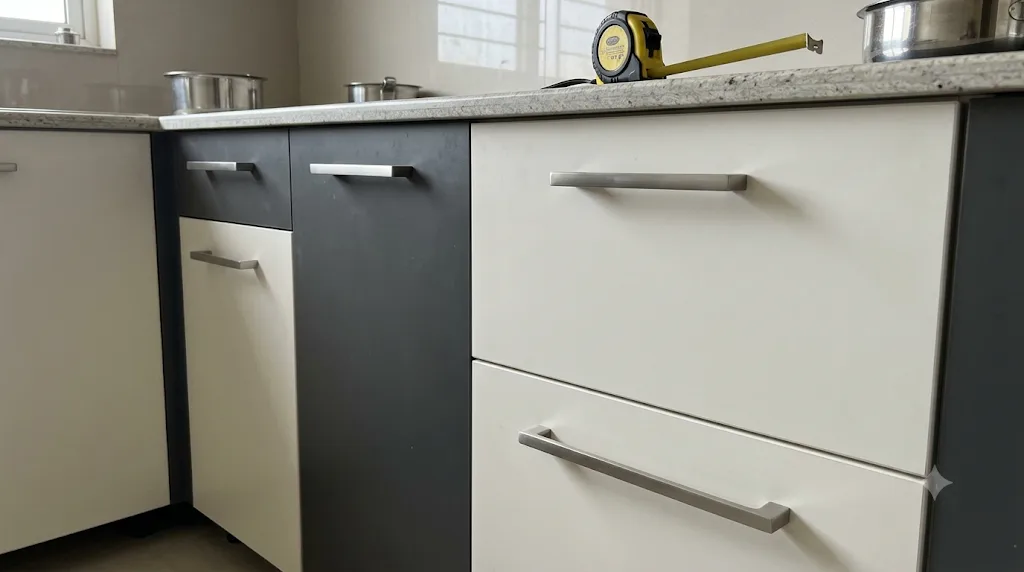
Cabinet handle styles compared
Good choices
- Bar (T-bar) handles: Timeless, easy to grip, easy to clean.
- G-profile and J-profile (gola) handles: Aluminium profiles for a sleek, handleless kitchen.
- Edge / lip pulls: Minimal handles on the top edge of the shutter.
- Push-to-open: No handle at all, paired with push-to-open channels and hinges.
Think twice about
- Sharp-edged or very ornate handles in busy kitchens, since they catch clothes and collect grease
- Protruding knobs on narrow walkways, especially with kids
- Unbranded plated zinc handles near the sink or hob
- Mixing too many styles in one kitchen
Which handle should you buy?
Main door
Heavy brass or SS mortise handle set with a good lock, or a smart lock.
Bedroom doors
Lever handle on plate or on rose, satin nickel or PVD finish.
Bathroom doors
SS 304 privacy lock with emergency release.
Kitchen and wardrobe
128–192 mm bar handles or G/J profiles; long pulls on tall wardrobe doors.
Comparing brands? Read Dorset vs Ozone for handles and mortise locks, Godrej vs Yale for main door locks, and our smart door lock buying guide. You can also browse brand ranges on the Godrej and Hettich websites. See our earlier door handles and locks guide for Dhakoli homes and our full range of hardware products. Fitting the rest of the kitchen? Read how to choose hinges, how to choose a telescopic channel and how to choose taps, all in our How to Choose series.
Choose handles in person at our Dhakoli store
Hold them, try the lever action and compare finishes side by side. Or WhatsApp us your door or cabinet photos and we will suggest handles, sizes and quantities.
SCO 13, Ground Floor, Srishti Plaza, opp. DWPS, Dhakoli, Zirakpur 160104 · Free delivery above ₹500 in Dhakoli & nearby
Frequently asked questions
How do I choose the right door handle?
Match the handle to the door. Use a lever handle on plate with a mortise lock for main and bedroom doors, a privacy lock with an emergency release for bathrooms, and a strong brass or SS 304 set for the main door. Levers are easier than knobs for children and elderly people. Also check the door's handing and thickness before buying.
What size cabinet handle should I use?
Cabinet handles are sized by the centre-to-centre distance between screw holes, commonly 96, 128, 160, 192, 224 and 320 mm. A handle about one-third of the drawer width looks balanced, so a 600 mm drawer suits a 160–192 mm handle. Tall wardrobe doors look best with 300–600 mm long pulls.
Which material is best for door handles?
Solid brass and stainless steel (SS 304) are the most durable materials for door handles. Brass gives a premium, heavy feel, while SS 304 is rust-proof and ideal for bathrooms and exterior doors. Zinc alloy handles are fine from trusted brands, but avoid plain iron, which rusts.
Handle finish and style questions
Which handle finish lasts longest?
Satin or brushed nickel and matt stainless steel finishes last well and hide fingerprints and scratches. For coloured finishes such as gold, rose gold or black, choose PVD coatings, which resist wear much better than ordinary plating.
What is the difference between mortise handles and handles on rose?
A mortise handle set has lever handles on a long plate and works with a mortise lock body fitted inside the door, which is common on Indian main and bedroom doors. A handle on rose sits on a small round or square base and works with a separate latch or lock, giving a more modern, minimal look.
What are G profile and J profile handles?
G profile and J profile handles are aluminium profiles fixed along the top edge of kitchen shutters or drawers. They create a groove to hold, so the kitchen looks handleless and sleek, with nothing sticking out to catch clothes.
Which brands make good door handles in India?
Dorset, Godrej, Ozone, Yale, Häfele and Hettich are among the trusted brands for door and cabinet handles in India, with options from budget to premium.