
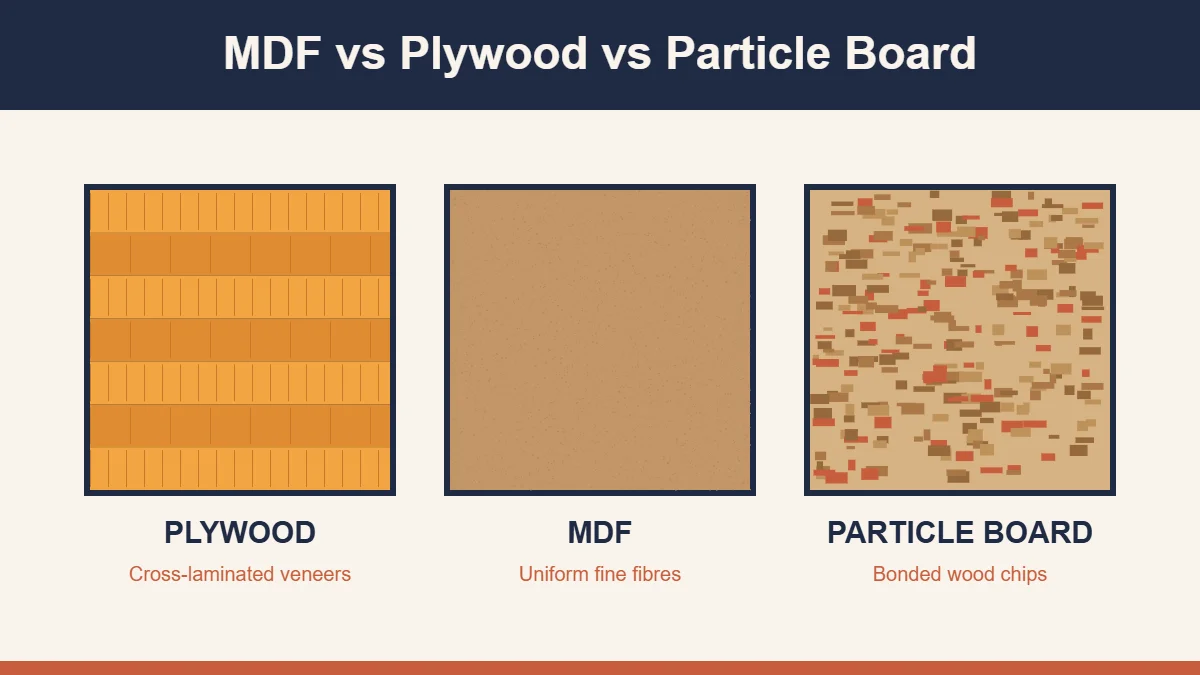
Short answer: Use plywood for anything that carries weight, gets screwed together repeatedly, or may meet water, such as kitchen carcasses, wardrobes and long shelves. Use MDF where you want a smooth, painted or routed finish, like cabinet shutters and decorative panels. Use particle board for budget, dry-area furniture that won’t be moved or reassembled often.
All three come in similar sheet sizes, typically 8 x 4 ft (about 2440 x 1220 mm), and similar thicknesses, so they can look interchangeable on a shop shelf. They behave very differently once they’re built into a cupboard and used for ten years. This guide explains the difference and shows which board suits each part of a piece of furniture.
What is each board actually made of?
Plywood is made from thin sheets of wood veneer glued on top of each other. The grain of each layer runs at right angles to the one below it. That cross-layering gives plywood strength in every direction and helps it resist warping. The glue type decides how well it copes with moisture.
MDF (medium-density fibreboard) is made by breaking wood down into fine fibres, mixing them with wax and a resin binder, and hot-pressing the mix into panels. The result is dense and uniform, with no grain, knots or voids. Typical MDF has a density of roughly 600 to 800 kg per cubic metre (about 37 to 50 lb per cubic foot, source), so it is noticeably heavy.
Particle board (also called chipboard) is made from larger wood chips and particles bonded with resin. It is the cheapest of the three and the lightest per sheet. Most flat-pack furniture uses it, usually with a melamine or laminate face already applied (“pre-laminated particle board”).
How do they compare side by side?
| Property | Plywood | MDF | Particle board |
|---|---|---|---|
| Strength and stiffness | Highest | Medium | Lowest |
| Screw holding (face) | Very good | Good with pilot holes | Fair; weakens if re-screwed |
| Screw holding (edge) | Good | Poor; can split | Poor |
| Resistance to sagging on long shelves | Best | Sags over long spans | Sags most |
| Moisture tolerance (standard grades) | Depends on glue; BWR/BWP grades cope well | Swells if wet | Swells badly and crumbles if wet |
| Surface for paint | Needs filling; grain may show | Excellent, very smooth | Poor unless laminated |
| Routing and shaped edges | Shows layers | Excellent | Not suitable |
| Weight | Medium | Heaviest | Lightest |
| Relative cost | Highest | Middle | Lowest |
Which board should you use for each part of your furniture?
You rarely have to pick one board for a whole project. Good furniture often mixes them, putting the strong board where the load is and the smooth board where the finish shows.
| Furniture part | Best choice | Why |
|---|---|---|
| Kitchen base cabinets, especially under the sink | Water-resistant plywood (BWR/BWP) or a high-moisture-resistant board | Leaks and cleaning water destroy standard MDF and particle board |
| Bathroom vanity | BWP or marine-grade plywood | Constant humidity and splashes |
| Wardrobe carcass (sides, top, base) | Plywood; pre-laminated particle board on a budget | Carries hanging load and hinges |
| Long shelves (books, heavy items) | Plywood | Resists sagging over time |
| Painted cabinet shutters, shaker-style doors | MDF (moisture-resistant grade in kitchens) | Smooth paint finish and clean routed profiles |
| Decorative wall panels, headboards | MDF | Easy to shape and paint |
| Drawer bottoms and cabinet backs | Thin plywood or thin MDF, e.g. 6 mm (about 1/4 in) | Light load; low cost matters |
| Study table or TV unit in a dry room | Any of the three; particle board is fine if it won’t be moved | Low moisture and moderate load |
| Furniture you’ll dismantle when you move house | Plywood | Survives being unscrewed and re-screwed |
For thickness, carcasses and shelves are commonly built in 18 mm (about 3/4 in) board. Our guide to 18 mm vs 12 mm plywood covers when a thinner sheet is enough.
Is MDF stronger than plywood?
No, not in the way that matters for furniture. MDF is denser and heavier, but plywood is stiffer and holds fixings better, especially at the edges. Screws driven into the edge of MDF tend to split it unless you drill a pilot hole first. MDF is still stronger and more uniform than particle board, which is why it is the usual choice for doors and panels that need a flawless surface.
Which board handles moisture best?
Plywood made with water-resistant glue handles moisture best. In India, plywood grades are defined by the Bureau of Indian Standards: general-purpose plywood under IS 303 comes in moisture-resistant (MR) and boiling-water-resistant (BWR) grades, and marine plywood is covered by IS 710. If you’re choosing between grades, see our comparison of marine plywood vs BWR plywood.
Standard MDF and particle board swell when water soaks into an exposed edge, and the swelling doesn’t go back down. Moisture-resistant MDF exists and is often dyed green so you can recognise it. In Europe it is classified under EN 622-5. It copes with humid rooms, but it is still not waterproof. In India you’ll also find high-density, high-moisture-resistant (HDHMR) boards sold for kitchens and wardrobes, which sit between MDF and plywood in behaviour.
Whatever board you choose, seal every cut edge. Edge banding or a sealing coat stops moisture getting in where damage usually starts.
What should you check before buying?
- The grade marking. Look for the standard printed on the sheet. In India that’s IS 303 or IS 710 for plywood, IS 12406 for MDF and IS 3087 for particle board. In the USA, MDF, particleboard and hardwood plywood must be labelled “TSCA Title VI compliant” for formaldehyde emissions (US EPA). Europe and other markets use their own emission classes, such as E1.
- Actual thickness. Measure it with a tape or vernier. A sheet sold as 18 mm should be close to that all over.
- Flatness. Sight along the sheet or lay it flat. A board that’s already bowed will not straighten in a cabinet.
- The edges. On plywood, look for gaps or overlaps between the inner layers. On MDF and particle board, look for crumbling edges or loose particles.
- The face. Check pre-laminated boards for chips, bubbles or scratches in the laminate, because these can’t be repaired invisibly.
- Where it will be used. Tell your supplier or carpenter which room and which part of the furniture it’s for, so the grade matches the job.
Common mistakes
- Using standard MDF or particle board under a sink. A slow leak is often noticed only after the base panel has swollen beyond repair.
- Leaving cut edges bare. Unsealed edges soak up humidity, even in rooms that seem dry.
- Long, heavily loaded shelves in MDF or particle board. They look fine on day one and bow within months. Use plywood, add a middle support, or fix a hardwood strip under the front edge.
- Re-using screw holes in particle board. Each time a screw is removed and driven back, the hole gets weaker. Particle board is best assembled once.
- Heavy fittings on weak board. Soft-close hinges and drawer channels need a board that holds screws firmly. Our guides on choosing cabinet hinges and choosing telescopic drawer channels explain what to pair with each.
- Trusting “waterproof” on a label without a grade. Ask which standard and grade the claim refers to.
Safety when cutting these boards
Cutting and sanding any wood-based board creates fine dust, and MDF dust is especially fine. The UK Health and Safety Executive notes that wood dust, including dust from MDF, can cause asthma, and that hardwood dust is linked to a rare nasal cancer (HSE). Its guidance is to control dust at the source with dust extraction, and to wear a well-fitted respirator such as an FFP3 mask as extra protection. For any DIY cutting, work outdoors or with a vacuum-connected saw, wear eye protection, and clean up with a vacuum rather than a broom.
These boards are bonded with resins that can release small amounts of formaldehyde, most noticeably when new. Choose boards certified to a recognised low-emission standard, and ventilate the room well for the first few weeks after new furniture is installed.
The quick decision guide
- Wet or humid area? BWR/BWP or marine plywood.
- Heavy load, long span or frequent reassembly? Plywood.
- Smooth painted finish or carved profile? MDF (moisture-resistant grade near kitchens).
- Dry room, tight budget, assembled once? Pre-laminated particle board.
Plywood is the safest all-round choice, MDF gives the best finish, and particle board is the most economical. Most well-made furniture uses each board where it does its job best.
Written by the team at Mahakal Hardware, a hardware and sanitary store in Punjab since 2005.